Retail and e-commerce
Driving consistent user acquisition
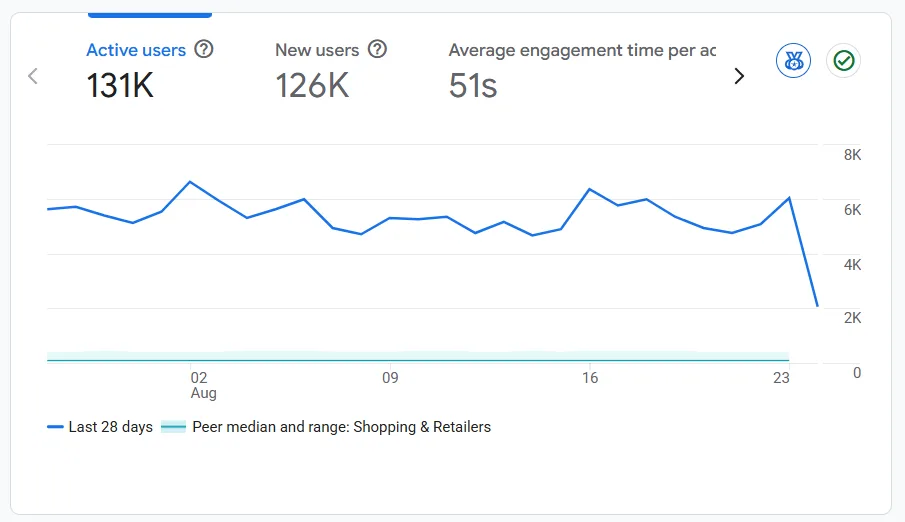
Consistent month-on-month user acquisition for a site benchmarked by GA4 against shopping and retail peers.
131KActive users
126KNew users
51sAvg. engagement time
Paid shopping ads keep getting more expensive. Organic rankings for your categories and products bring in buyers you don't pay for per click. I've helped retail sites acquire users consistently through organic search.
Paid shopping ads keep getting more expensive, and margins don't. Ecommerce SEO builds a channel you don't pay for per click: category pages that rank for what shoppers search, product pages that win rich results, and buying guides that capture people before they've chosen a brand.
My portfolio includes a retail site that brought in steady month-on-month user growth through organic search, benchmarked by Google Analytics against shopping and retail peers.
Category and collection pages target the highest-volume commercial searches, like "women's running shoes" or "standing desks". Yet many stores leave them as a grid of products with no text. I add useful copy that helps shoppers choose, improve internal links from related categories and guides, and tidy up filters so the right version gets indexed.
Manufacturer descriptions are copied across hundreds of competing stores. Unique descriptions, real specifications, sizing help, reviews and FAQs make product pages worth ranking. Product schema with price, availability and ratings helps them stand out in search results and shopping surfaces.
Each platform has its own quirks. Shopify creates duplicate product URLs through collections, WooCommerce can generate thousands of thin tag and attribute pages, and faceted navigation on any platform can create crawl traps. I fix canonicals, control which filtered pages get indexed, manage out-of-stock and discontinued products, and improve page speed.
Shoppers increasingly ask AI tools for product recommendations. Buying guides and comparison content that explain who each product suits, backed by real specifications and reviews, help both Google rankings and AI citations, and link straight to the products that solve the problem.
Category and collection pages target the highest-volume commercial searches, so they get keyword research, useful copy and internal links.
Unique descriptions, product schema with price and availability, reviews and image optimization.
Canonicals, faceted navigation, pagination and site speed on Shopify, WooCommerce and BigCommerce.
Content that answers pre-purchase questions and links to the products that solve them.
Examples of the kinds of queries a e-commerce SEO plan targets. Your actual keyword list comes from research on your market and competitors.
Rankings are a means, not the goal. Monthly reporting for e-commerce clients focuses on:
Consistent month-on-month user acquisition for a site benchmarked by GA4 against shopping and retail peers.
Yes, along with WooCommerce, BigCommerce and custom builds. Shopify has a few specific technical limits I work around, such as forced URL structures and duplicate collection paths.
Not always. Out-of-stock, near-duplicate or very thin variants are often better consolidated, so crawl budget and authority go to pages that can rank and sell.
Category pages, because they target the highest-volume buying searches. Then technical issues like duplicate URLs and filter pages, then product pages and buying guides.
Shopify is solid for most stores, with some fixed limitations such as URL structure and duplicate collection paths. Those can be managed with canonicals and internal linking.
Technical fixes can show results within weeks. Category page improvements usually show within two to four months, and competitive head terms take longer.
Send your website and I'll check your Google rankings and what ChatGPT, Perplexity and AI Overviews say about your business. You get the gaps and the first fixes on a free 30-minute call.